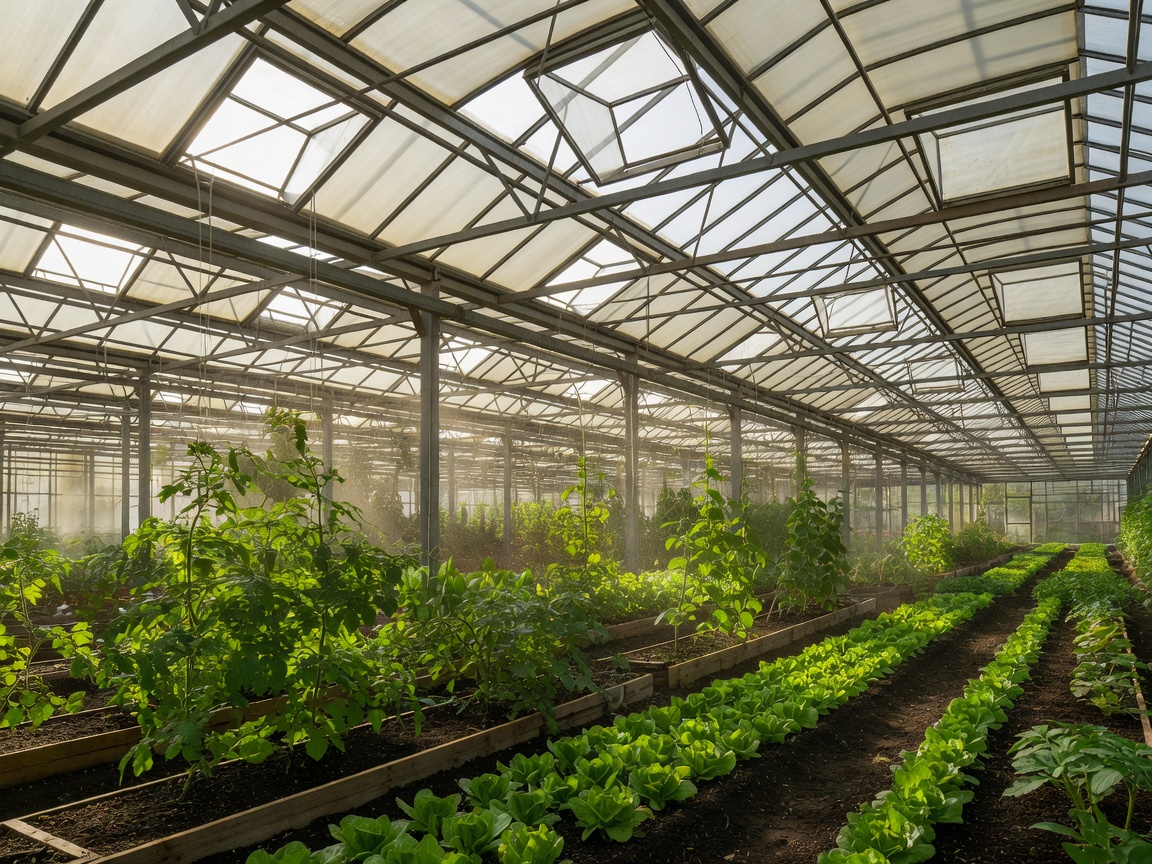
Specify a balance, not a collection of devices
A greenhouse gains and loses heat through sunlight, the covering, air exchange, heating equipment and the crop. Moisture enters the air through plant transpiration and wet surfaces, then leaves through ventilation, condensation or dedicated removal equipment. A climate design has to consider these pathways together. Buying a heater and a fan separately does not establish that the growing environment will remain controllable.
Write operating objectives as conditions with boundaries. Define the intended crop process, seasonal use, external design conditions and acceptable responses when outdoor conditions make a target unreachable. Identify whether the requirement applies at canopy height, in a propagation zone or across an entire compartment. A single room-average value can conceal important local differences.
Wageningen University & Research publishes greenhouse research that illustrates the interaction of energy, crop processes and environmental control. The University of Arizona Controlled Environment Agriculture Center also provides useful context for controlled-environment production. These are starting points for understanding principles, not substitutes for a site-specific design calculation.
Understand what each system can change
Natural ventilation exchanges indoor and outdoor air through openings driven by wind and buoyancy. Its behavior depends on opening geometry, wind direction, insect screens, nearby obstacles and the temperature difference across the enclosure. A larger actuator does not compensate for an opening whose effective airflow is restricted.
Circulation fans mainly redistribute air within the space. They can improve mixing, but they do not inherently remove moisture from the greenhouse. Mechanical extraction creates a different airflow path and needs correctly sized replacement-air openings. Evaporative cooling adds moisture while lowering air temperature under suitable conditions, so its usefulness depends strongly on the incoming air.
Heating changes air temperature and the heat exchange around plants and surfaces. Pipe location, emitter distribution and hydraulic balancing affect uniformity. A thermal screen can reduce heat exchange but also alters air movement and moisture distribution. Every screen strategy should be examined for what happens above and below the screen, especially during opening and closing transitions.
Measure where the crop experiences the system
A sensor close to a heating pipe, sunlit frame or open vent may report a condition that is not representative of the canopy. Specify sensor locations, shielding, aspiration where appropriate and maintenance access. If a sensor is moved as the crop grows, document the intended position so trends remain interpretable.
Relative humidity is the amount of water vapour present compared with saturation at the same temperature. Vapour pressure deficit, often shortened to VPD, expresses a pressure difference related to the air's drying potential. Neither value alone measures plant water status. Leaf temperature, root conditions and the crop's development all influence interpretation.
Sensor accuracy also needs context. A factory specification describes a device under stated conditions; installed performance includes contamination, radiation exposure, cable faults and calibration history. Record checks against a suitable reference and define how an implausible reading will be detected.
Prevent equipment from working against itself
A control sequence should explain which objective takes priority when conditions conflict. Heating while ventilating can be intentional for moisture management, but uncontrolled overlap can waste energy. Similarly, a screen may improve heat retention while obstructing the airflow needed for a humidity strategy. Define the permitted combinations rather than relying on separate equipment defaults.
Hysteresis is a separation between switching thresholds that helps prevent repeated on-off cycling around one value. Staging brings equipment into operation in an agreed order. Both require tuning to the actual system response. Very aggressive adjustments can make a slow greenhouse process oscillate, even when each individual device appears to work correctly.
Document weather overrides and mechanical limits. A vent may need protection during high wind or rain, but that protection can reduce cooling capacity. The operating plan should state the resulting limitation and how staff are notified. It should not silently replace one risk with another.
Commission transitions, not just steady operation
Test movement direction, end positions, fan rotation, heating distribution and sensor plausibility before adjusting climate recipes. Then observe transitions: sunrise, screen opening, a change in wind, a heating stage starting and recovery after a power interruption. These moments often expose interactions that a static equipment checklist misses.
ASHRAE publishes engineering references on heating, ventilation and air conditioning, while CIBSE provides building-services guidance. Use relevant principles with awareness that a cropped greenhouse is not a conventional occupied building. Crop transpiration and solar exposure create distinct operating conditions.
Finally, connect the climate plan to water delivery. Irrigation changes the water available for transpiration; climate changes demand. Neither subsystem can be evaluated fully in isolation, and neither guarantees a particular crop outcome.