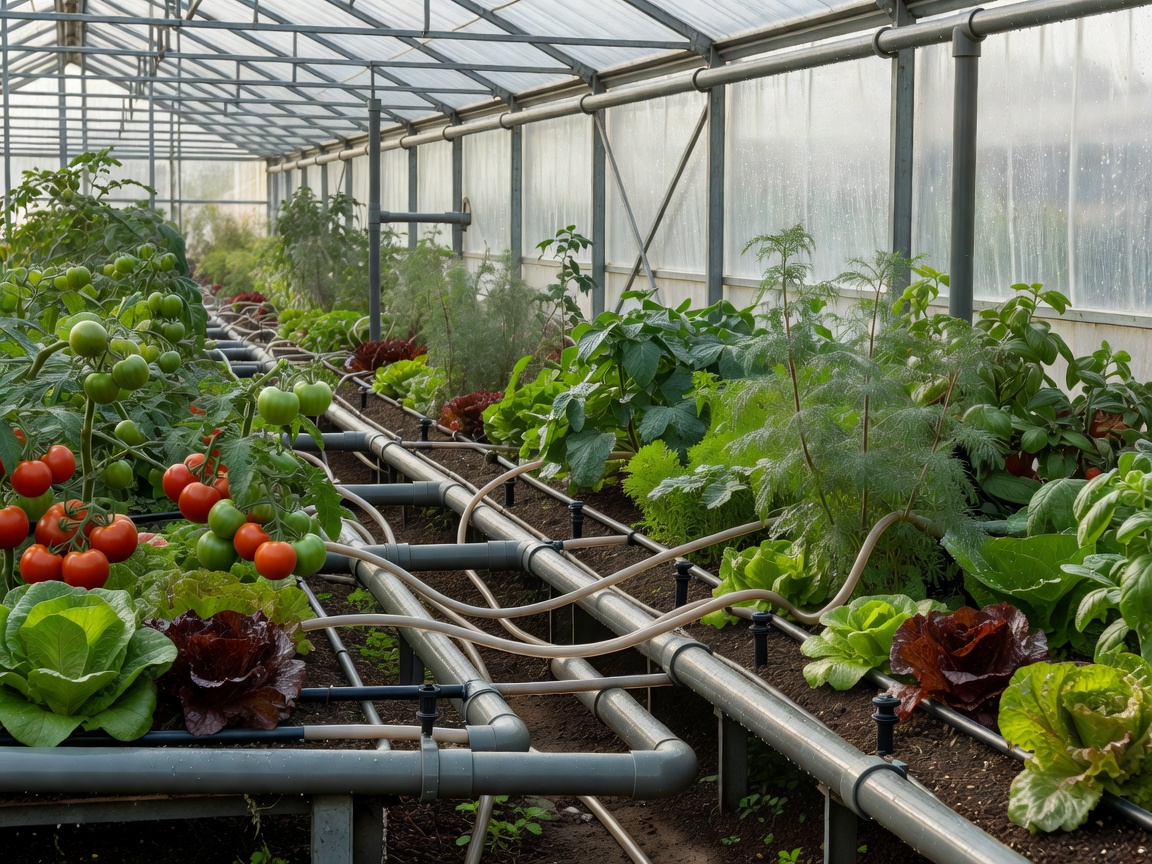
Begin with the water you actually have
A pump specification is not the starting point for an irrigation design. First identify the source, seasonal availability, quality variation and any restrictions on use. Mains water, collected rainwater and borehole water can present different treatment needs. A storage tank can buffer availability, but storage also introduces requirements for cleaning, overflow management and protection against contamination.
Obtain a relevant laboratory analysis and interpret it with a competent crop or water specialist. Salinity, alkalinity and particular dissolved ions affect treatment and nutrient formulation in different ways. Water that looks clear can still create chemical or biological problems. Sampling procedures and timing matter because one sample may not represent the whole season.
The Food and Agriculture Organization of the United Nations, commonly FAO, provides irrigation and water-quality resources. These are useful for understanding concepts, but a greenhouse nutrient programme still requires crop-specific interpretation. Do not turn a general reference range into an automatic dosing instruction.
Separate filtration, treatment and nutrient dosing
Filtration removes particles within the filter's operating capability. It does not automatically remove dissolved salts or make water microbiologically safe. Treatment may involve other processes chosen for a defined hazard or quality objective. Specify each process by the problem it solves, the incoming conditions it can tolerate and the maintenance it requires.
Fertigation means supplying nutrients through irrigation water. A dosing unit may combine stock solutions with source water, but the design must address mixing, chemical compatibility, backflow prevention and safe handling. Concentrated products should be stored and used according to their safety information and applicable requirements. This guide is not a chemical mixing procedure.
Electrical conductivity, or EC, indicates the solution's ability to conduct electricity and is commonly used as an indicator of dissolved ionic content. It does not reveal the complete nutrient composition. pH describes acidity or alkalinity on a logarithmic scale; it is not the same as alkalinity, which concerns buffering capacity. Use measurements for their actual purpose rather than treating either value as a complete water-quality diagnosis.
Design distribution around the least-favoured outlet
A distribution network must deliver acceptable conditions across the zone, not merely at the pump. Pipe length, internal diameter, fittings, elevation changes and simultaneous demand affect pressure and flow. Define which zones may operate together, then evaluate the hydraulic condition at representative and least-favoured locations.
Emitters need compatible operating conditions and a maintenance plan. Pressure-compensating devices can help within their specified range, but they cannot correct every network problem or recover from unrestricted blockage. Provide flushing points and access to filters, isolation valves and measurement locations. A serviceable layout is more valuable than a compact layout that cannot be inspected.
| Measurement | What it helps show | What it does not prove |
|---|---|---|
| Pressure | Hydraulic conditions at a location | Equal delivery from every emitter |
| Flow | Volume passing a meter over time | Correct distribution within the crop |
| EC and pH | Selected solution properties | Complete nutrient balance or hygiene |
| Drainage observation | Outflow behavior from the growing system | Uniform root-zone conditions everywhere |
Make recovery a separate engineering decision
Recirculation can reduce discharge, but it also moves drainage water back into the supply chain. The system must account for collected volume, solution composition, pathogen risks and the limitations of any treatment stage. A closed-loop label is not evidence that all contaminants are controlled or that nutrient balance remains suitable indefinitely.
Separate roof-water collection from nutrient drainage where their intended uses and quality requirements differ. Specify clear tank identification and pipe labelling. Prevent unintended connections to drinking-water systems; EN 1717 is a relevant European reference for protection against pollution of potable water installations, subject to local implementation and the actual installation type.
Discharge arrangements need local review. In England, the Environment Agency provides guidance on environmental permitting and water abstraction. Other jurisdictions have different authorities and rules. Confirm requirements before designing a disposal or recovery strategy around an assumed permission.
Commission with water before relying on recipes
Verify pipe identification, valve operation, pump protection and the response to low storage levels. Flush the system appropriately and inspect for leaks. Check meters and compare representative outlet deliveries under the intended zone combinations. Record test conditions so later investigations have a meaningful baseline.
ISO 9261 concerns agricultural irrigation emitters and emitting pipe specifications and test methods within its scope. It can inform product evaluation, but product testing does not replace verification of the installed network. Ask suppliers to distinguish component evidence from whole-system performance.
Connect irrigation schedules to observation, crop advice and the climate strategy. Automation can repeat a command consistently; it cannot establish that the underlying agronomic decision is appropriate. The control specification should therefore show what staff can review, override and investigate.